
OpenRouter Alternatives in Europe: AI Gateways by Company, Provider Access and Logging
 Niklas KarolyFounder Nodion
In short
- OpenRouter is a US company in New York; it does not store prompts unless you opt in (content flagged as potential CSAM excepted), zero data retention routing is available on every plan but has to be switched on, and EU in-region routing needs the Business or Enterprise plan.
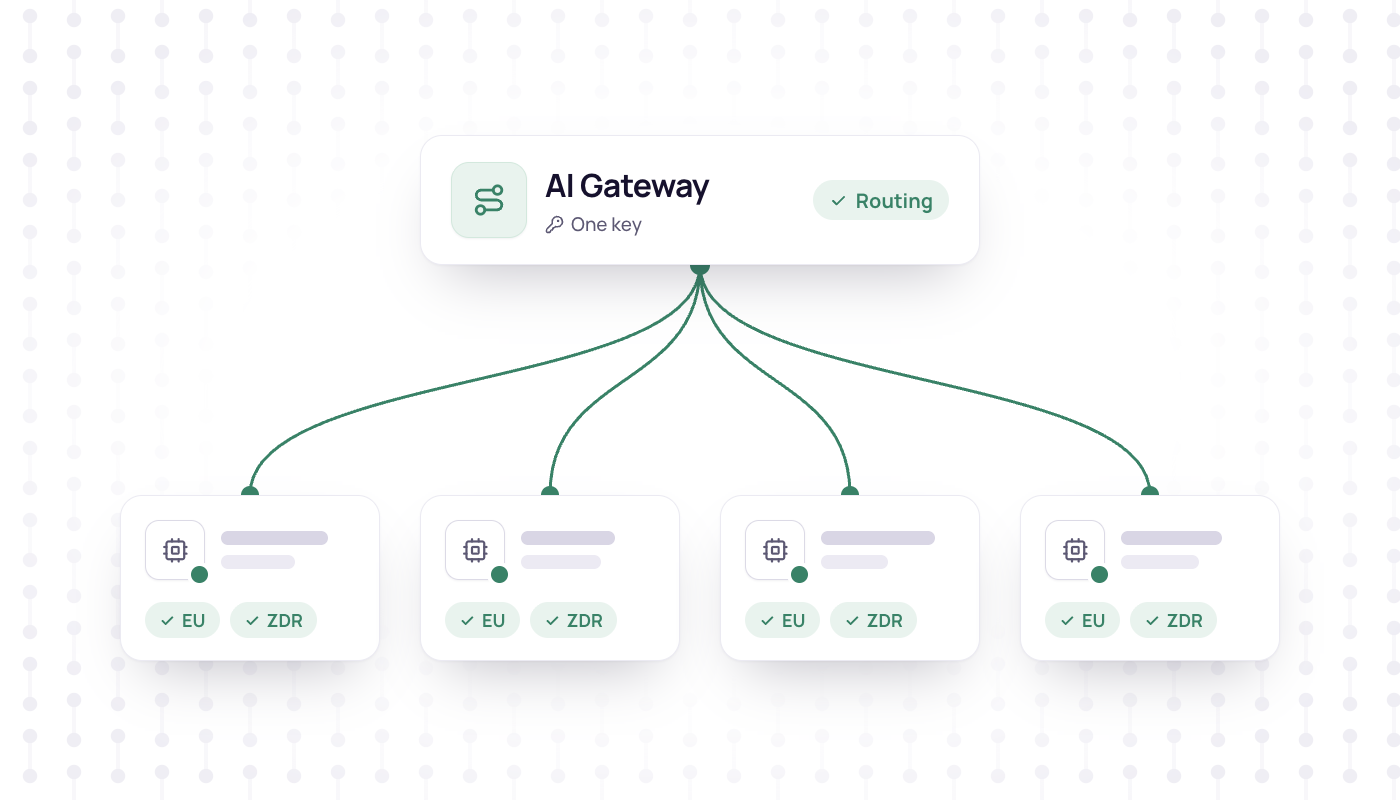
- Nodion (Stuttgart) is the only company based in the EU in this comparison; its gateway routes only to providers based in the EU, all serving with zero data retention, and needs no provider accounts.
- Vercel AI Gateway is a hosted US gateway on prepaid credits with EU inference you turn on per request; Cloudflare AI Gateway and Portkey are hosted US gateways that mainly work with your own provider keys and keep request logs by default that can include prompts and responses; LiteLLM is an open source gateway you run yourself.
- Switching takes a new base URL (
https://api.nodion.ai/v1), a Nodion key and a model id from the AI Inference catalog.
OpenRouter gives you one API key for models from many providers. If you work in the EU and want the same with a different setup, this comparison looks at five alternatives: Nodion, Vercel AI Gateway, Cloudflare AI Gateway, Portkey and LiteLLM. Among the options compared, Nodion is the only company based in the EU. Each option is measured on five points: where the company is based, whether it is hosted or you run it yourself, whether you need your own provider accounts, what is logged by default, and which EU options are documented. As of October 2026; prices and fees are left out, because they change.
What OpenRouter is
OpenRouter, Inc. is a US company based in New York, and its terms are governed by New York law. It offers one API, very similar to the OpenAI Chat API, in front of models from many providers. You pay from prepaid credits; your own provider keys (BYOK) are optional, so you do not need accounts with the providers.
On data, OpenRouter documents three defaults. It does not store your prompts or responses unless you opt in to logging or content is flagged as potential child sexual abuse material (CSAM), which its policy allows it to keep; it does store metadata such as token counts and latency for every request. Zero data retention (ZDR) routing, which only uses providers that do not store your data, is available on every plan, but you have to switch it on, in the privacy settings or per request. And European in-region routing through eu.openrouter.ai is available on the Business and Enterprise plans: prompts and completions are then decrypted in Europe (EU/EEA, UK and Switzerland) and routed only to provider endpoints there, while account data, billing records and security logs may be stored or processed in the US.
Sources, checked October 2026: OpenRouter terms, API overview, BYOK, data collection, zero data retention, in-region routing, plans.
Why EU teams look at alternatives
A gateway sits between your code and the model providers, so it sees every prompt. Four questions decide whether one fits an EU setup:
- Where the company is based. An EU region decides where data is processed; the company decides which law can reach it. A US gateway stays subject to US law, even with an EU endpoint.
- Who the providers are. The gateway forwards your prompts to providers. Where they are based and what they keep matters as much as the gateway itself.
- Whether you need your own provider accounts. Every account is another contract, another set of terms and another processor for your data protection records.
- What is logged by default. Some gateways keep prompts and responses in their logs until you turn that off.
At a glance
| Option | Company and HQ | Hosted or run yourself | Access to models | Logging default (as documented) | EU options (as documented) |
|---|---|---|---|---|---|
| Nodion | Nodion GmbH, Stuttgart, Germany | Hosted | One Nodion key, no provider accounts | Request log with operational metadata (model, tokens, latency, amount); for Nodion-hosted models the AI DPA rules out prompts and outputs in it | Routes only to providers based in the EU |
| Vercel AI Gateway | Vercel Inc., USA | Hosted | Prepaid credits, no provider accounts; own provider keys optional | Gateway deletes prompts and responses after the request; provider ZDR optional from Pro | EU inference per request (since July 2026); gateway region not pinned |
| Cloudflare AI Gateway | Cloudflare, Inc., San Francisco, USA | Hosted on Cloudflare's network | Mainly your own provider keys; optional Unified Billing credits | Logs on per gateway, can include prompt and response; can be turned off | Listed by Cloudflare as not supported for Regional Services |
| Portkey | Portkey, Inc., San Francisco, USA; part of Palo Alto Networks | Hosted, Enterprise hybrid, or open source gateway | Your own provider keys | Request and response logged; the per-request opt-out keeps tokens, cost and latency | On the Enterprise plan (regional routing or hybrid) |
| LiteLLM | BerriAI, San Francisco, USA | You run it (open source, MIT) | Your own provider keys and contracts | Nothing stored at BerriAI when you run it; logging is your setup | Wherever you run it |
1. Nodion
Nodion AI Inference is the AI gateway of Nodion GmbH, based in Stuttgart, Germany. It routes only to providers based in the EU, all serving with zero data retention. You need no account with these providers: you call every model through Nodion with one Nodion API key, paid from a prepaid wallet or, for coding agents, with an AI Coding Plan.
The API at https://api.nodion.ai/v1 is OpenAI-compatible, with /v1/chat/completions and the Responses API at /v1/responses, which Codex CLI uses. The Responses endpoint is stateless: it stores no responses, so the client sends the whole conversation, as Codex does. When a provider cannot be reached, the next requests go to the other providers your project allows. In the project's AI settings you allow or exclude providers yourself.
The catalog lists chat models such as Kimi K3, GLM 5.3, DeepSeek V4.1 Flash and Qwen3.8 27B. Each model page shows the model's providers with latency, throughput and uptime over the last 24 hours. Keys, usage and these settings live in the same project as your app, and every key can have an expiry date and a daily spend limit.
Best for: teams that want OpenRouter's one-key model, but with an EU company and only providers based in the EU.
Sources: AI Inference docs, AI Inference DPA, Responses API, AI Inference catalog, AI Coding Plans, Portkey logs.
2. Vercel AI Gateway
Vercel AI Gateway comes from Vercel Inc., a US company, and is available on all Vercel plans; your app does not need to run on Vercel. One endpoint is OpenAI-compatible for chat completions and the Responses API and also speaks the Anthropic Messages API. Access runs on prepaid credits at Vercel, so you need no provider accounts; you can add your own provider keys on top.
According to Vercel, the gateway itself uses zero data retention by default and deletes prompts and responses after the request; request logs hold data such as model, provider, latency, tokens and cost. Zero data retention at the providers is a separate option for Pro and Enterprise users, and by default the gateway does not route based on the providers' data retention. Inference in the EU can be turned on per request since July 2026; according to Vercel, a request can still reach and be processed by the gateway in any Vercel region before it goes to the provider.
Sources: AI Gateway, credits and own keys, zero data retention, regional inference, changelog July 2026, Vercel terms.
3. Cloudflare AI Gateway
Cloudflare AI Gateway runs on Cloudflare's network and is available on all Cloudflare plans. Cloudflare, Inc. is a US company based in San Francisco. You mostly bring your own provider keys, sent with the request or stored with Cloudflare. With the optional Unified Billing you call providers such as OpenAI, Anthropic and Google AI Studio from prepaid Cloudflare credits, without provider keys. It adds an OpenAI-compatible chat completions endpoint, retries and model fallback.
Logs are enabled by default for each gateway. A log entry can include the prompt, the response, the provider, token usage and cost. You can turn logging off per gateway, per request, or for the payload only. Cloudflare's zero data retention option applies to Unified Billing traffic, not to requests with your own keys, and it does not control the gateway's logging. The compatibility matrix of Cloudflare's Data Localization Suite lists AI Gateway as not supported for Regional Services.
Sources: AI Gateway, plans, Unified Billing, chat completions, logging, Data Localization Suite, Cloudflare terms.
4. Portkey
Portkey, Inc. started in San Francisco in 2023 and has been part of the US company Palo Alto Networks since May 2026, where it becomes the AI gateway of Prisma AIRS. Portkey comes as a hosted service, as an Enterprise hybrid with the data plane in your own cloud, and as an open source gateway (MIT) that you run yourself. Its API at https://api.portkey.ai/v1 works with the OpenAI SDK.
You connect your own provider accounts: in Portkey you add each provider with your API key, and Portkey adds routing, retries, fallbacks and observability on top. The logs show full request and response objects; per request, the header x-portkey-debug: false keeps only tokens, cost and latency. EU data residency is part of the Enterprise plan: Portkey lists regional data routing (US, EU, India) among its enterprise controls, and the hybrid setup keeps prompts and responses inside your network.
Sources: Portkey info, Palo Alto Networks acquisition, plans, model catalog, logs, hybrid, open source gateway.
5. LiteLLM
LiteLLM is an open source AI gateway (MIT license) by BerriAI (Berrie AI Incorporated), a San Francisco company from Y Combinator's W23 batch. You run it yourself: it puts the providers you configure behind one OpenAI-compatible API, with load balancing, budgets, virtual keys and guardrails in the free version.
Because LiteLLM does not resell models, you hold your own account and contract with every provider you use; prompts go only to the providers you configure. When you run it yourself, LiteLLM says no data or telemetry is stored on LiteLLM's servers, and usage telemetry is off by default. Where the gateway runs is your choice; where the prompts are processed next depends on the providers and contracts you pick.
Sources: LiteLLM, data security, Enterprise, Y Combinator.
Moving from OpenRouter to Nodion
- Base URL: replace OpenRouter's URL with
https://api.nodion.ai/v1. - Key: create an inference key under AI Inference → Keys; it starts with
nodion_ai_. - Model: use a Nodion model id such as
moonshot/kimi-k3orz-ai/glm-5.3from the catalog. - Coding agents: step by step for Codex CLI, OpenCode, and Aider, Cline and Continue; the SDK switch is in OpenAI-Compatible API with EU Routing.
How to choose
- One key for many models, no provider accounts, at an EU company: Nodion, with a prepaid wallet or an AI Coding Plan.
- Only providers based in the EU, with zero data retention: Nodion routes to such providers only.
- A subscription for your coding agent: Nodion AI Coding Plans, compared with other plans in AI Coding Plans Compared.
- Before you pick any gateway: check the company behind it, its logging default and the providers your prompts reach; what zero data retention covers lists what to ask.
Frequently asked questions
What is the best OpenRouter alternative in Europe?
Nodion, if you want one API key for many models without provider accounts, routed only to providers based in the EU that all serve with zero data retention. Among the options compared here, it is the only company based in the EU.
Does OpenRouter have EU routing?
Yes, on the Business and Enterprise plans: requests to eu.openrouter.ai are processed in Europe (EU/EEA, UK and Switzerland) and routed only to provider endpoints there. Account data, billing records and security logs may still be stored or processed in the US.
Does OpenRouter store my prompts?
According to OpenRouter, not unless you opt in to logging, with one exception: content flagged as potential child sexual abuse material may be kept. It does store metadata such as token counts and latency for every request. Zero data retention routing is available on every plan but has to be switched on.
Do I need my own provider accounts for an AI gateway?
Not with Nodion: one Nodion key calls every model in its catalog. Vercel AI Gateway also works without provider accounts, on prepaid Vercel credits. Cloudflare AI Gateway mainly uses your own provider keys, with optional Unified Billing for some providers, and Portkey and LiteLLM work with your own provider keys.