
Zero Data Retention for LLM APIs: What It Means and How to Check It
 Niklas KarolyFounder Nodion
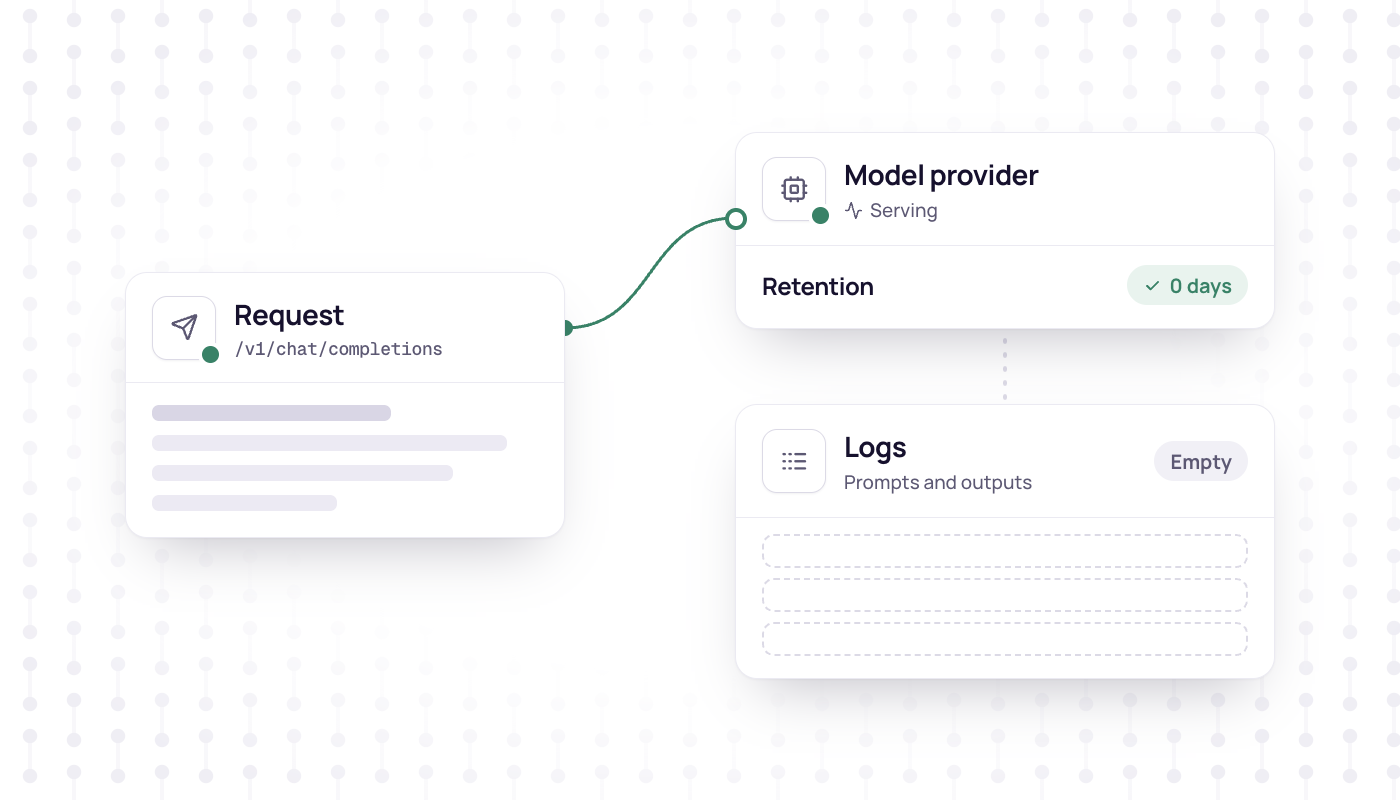
In short
- The Nodion AI Gateway routes only to providers based in the EU, all serving with zero data retention; the AI Inference DPA covers prompts and outputs on Nodion-hosted models.
- Zero data retention (ZDR) is not a standard or legal term: each LLM API provider defines it in its own docs, grants it in its own way and lists its own exceptions.
- By default, OpenAI keeps abuse monitoring logs for up to 30 days, Mistral keeps inputs and outputs for 30 rolling days, Anthropic's commercial policy deletes them within 30 days, and the paid Gemini Developer API keeps them for 55 days.
- Even with ZDR, OpenAI, Anthropic and Mistral exclude stateful features such as files and batches, and OpenAI and Anthropic can keep flagged content, so check scope, caching, metadata and data location per provider.
Zero data retention (ZDR) means, at its core, that an LLM API provider does not keep your prompts and outputs once the response is returned. There is no shared definition, though. Each provider writes its own, grants it in its own way and lists its own exceptions. Below: what providers keep by default, how OpenAI, Anthropic, Google, Mistral, OpenRouter and Azure handle ZDR, and a checklist. As of October 2026.
Even the wording differs: OpenRouter defines it as a provider not storing your data "for any period of time", Anthropic as not storing prompts or responses "at rest after the API response is returned".
What providers keep by default, and why
The main reason is abuse monitoring: prompts and outputs sit in logs so that policy violations can be found. Stateful features such as files, batches or agents keep data longer.
- OpenAI: abuse monitoring logs for up to 30 days, which may contain prompts and responses. The Responses API keeps application state for 30 days by default.
- Anthropic: its commercial policy deletes API inputs and outputs within 30 days, with exceptions such as a ZDR agreement, the Files API, Usage Policy enforcement or the law.
- Mistral: input and output for 30 rolling days for abuse monitoring, unless ZDR is on; Agents API data until you close the account.
- Gemini Developer API: 55 days on the paid tier to detect policy violations. On the unpaid tier, Google may use content to improve its products, and human reviewers may read it.
- Vertex AI (now Gemini Enterprise Agent Platform): by model class and agreement, from flagged prompts only, for up to 90 days, to all prompts and responses for up to 30 days.
Training is separate: OpenAI, Anthropic and Google (paid API and Vertex) say they do not train on API data by default; at Mistral, ZDR and the training opt-out are separate controls.
Sources, checked October 2026: OpenAI data controls; Anthropic retention, training; Mistral privacy policy, ZDR; Google Gemini API terms, usage policies, Vertex abuse monitoring; definitions: OpenRouter, Anthropic.
Provider by provider
OpenAI
ZDR and Modified Abuse Monitoring (MAM) need prior approval by OpenAI. Both keep customer content out of the abuse monitoring logs; ZDR also treats store on /v1/responses and /v1/chat/completions as false. Endpoints that are not ZDR-eligible, such as files, vector stores, assistants, conversations, batches and fine-tuning, can still store state. Images and files flagged as potential CSAM are retained for review even under ZDR.
Anthropic
ZDR is arranged through the sales team, per organization. It covers the Messages and Token Counting APIs for eligible features. Batch processing (29 days), the Files API, the code execution tool (container data up to 30 days), the MCP connector and the Console are outside it, and models designated Covered Models require 30-day retention. The API does not block ineligible features: using one steps outside the ZDR arrangement for that data. Flagged content can be kept for up to 2 years.
Google: Gemini Developer API and Vertex AI
Google's own ZDR page for the Gemini Developer API says: "If your workload requires guaranteed zero data retention or enterprise data processing agreements, use Vertex AI." On Vertex, ZDR is a set of steps you take yourself: keep request-response logging off, set store to false on the Interactions API, and, if no data may be stored at rest, disable durable caching per project. Grounding with Google Search keeps data for up to 3 days and cannot be turned off; Google recommends Web Grounding for Enterprise instead.
Mistral
Mistral (Paris) offers ZDR only on pay-as-you-go and only for stateless API calls, such as chat completions, embeddings, OCR and audio. Agents, batch files, conversations, libraries and /v1/files are excluded. You request it through the Help Center with your reasons; Mistral decides at its discretion, and approved ZDR shows in the admin panel. Mistral's commercial terms let it train on data from Labs or Preview models even if you opted out elsewhere, including through ZDR.
OpenRouter
At OpenRouter, ZDR is an opt-in routing filter, per account, model group, guardrail or request: requests go only to endpoints whose policy OpenRouter records as zero retention, and an unclear policy counts as retaining and training. It does not cover plugins and tools such as web search, and OpenRouter does not count in-memory caching as retention. OpenRouter itself stores prompts and responses only if you opt in or content is flagged as potential CSAM, and keeps metadata such as token counts and latency. Its ZDR page announces CSAM screening of all requests, ZDR traffic included, from October 27, 2026. On Business and Enterprise plans, eu.openrouter.ai processes prompts and completions within the region.
Azure OpenAI
For Azure OpenAI models (now "Foundry Models sold by Azure"), prompts and completions are not available to OpenAI and do not train foundation models without permission. Flagged content held for human review is stored in your resource's geography. Turning that off (modified abuse monitoring) needs approval and is limited to customers with a Microsoft account team or an eligible program.
Sources: OpenAI data controls; Anthropic ZDR; Google Gemini API ZDR, Vertex ZDR; Mistral ZDR, commercial terms; OpenRouter ZDR, data collection, provider logging; Azure data privacy, limited access.
Prompt caching
Caches keep parts of a prompt briefly so that follow-up requests are faster. Lifetime, storage and the stance on ZDR differ:
| Provider | Lifetime | Where | Stance on ZDR |
|---|---|---|---|
| OpenAI | Minutes to 24 hours, by model and setting | KV tensors, also in GPU-local storage | "compatible with Zero Data Retention" |
| Anthropic | 5 minutes, refreshed on use; 1 hour as an option | KV representations and hashes in memory | ZDR-eligible |
| Vertex AI | Up to 24 hours, in-memory and durable both on by default | Durable cache at rest | Durable or all caching can be disabled per project |
| Gemini Developer API | Implicit 24 hours, explicit per your TTL | Implicit in RAM only | Implicit is compatible; avoid cached_content |
| OpenRouter | At the provider | Providers' in-memory caches | Not counted as retention |
OpenAI, Anthropic and Google isolate caches per organization or project.
Sources: OpenAI, Anthropic, Vertex, Gemini API, OpenRouter.
EU data location
Location is a separate promise from ZDR, and each provider sets it up differently:
- OpenAI: the Europe region (EEA and Switzerland) requires approval for MAM or ZDR and a Modified Retention amendment. System data such as account data, metadata and usage data is excluded.
- Anthropic: the data residency docs list
global(default) andusfor inference, andusas the only workspace geo. - Mistral: the default endpoint makes no commitment on inference location.
api.eu.mistral.aiprocesses in the EU, without stateful features; control-plane metadata may be handled outside the region. - Azure: standard deployments process in the chosen geography, DataZone deployments in EU member states, Global deployments in any geography.
- Gemini Developer API: data "may be stored transiently or cached in any country" where Google has facilities.
Sources: OpenAI, Anthropic, Mistral, Azure, Gemini API.
What the GDPR says
The GDPR does not use the term ZDR, but several articles of Regulation (EU) 2016/679 apply:
- Art. 5(1)(c), data minimisation: only as much personal data as the purpose needs.
- Art. 5(1)(e), storage limitation: kept no longer than necessary.
- Art. 25(2), data protection by default, explicitly including the period of storage.
- Art. 28: processors must give sufficient guarantees, sub-processors need authorisation, and the contract (DPA) sets duration, instructions and deletion.
- Art. 44: transfers to third countries only under the conditions of Chapter V, onward transfers included.
Short or zero retention means less personal data stored for less time; retention terms belong in the DPA; providers or sub-processors outside the EEA bring in Chapter V. This is background, not legal advice.
Checklist
- Default retention: how many days, for which purpose?
- Abuse logs: always or only when flagged, human review, opt-out?
- How ZDR is granted and enforced: approval, configuration or routing filter? Does the API block ineligible features?
- Scope: which endpoints are covered, which are excluded (files, batch, agents, fine-tuning)?
- Models: does any model require retention?
- Prompt caching: lifetime, memory or disk, can you turn it off?
- Training: defaults for paid API, free tiers, feedback and preview models.
- Flagged content and legal holds.
- Metadata and logs: token counts, latency, IP addresses, account data.
- Data location: inference and storage region, default or opt-in, exclusions.
- Subprocessors: published list, Art. 28 DPA, Chapter V transfer mechanism.
- Third-party tools: web search, code execution, file storage, MCP servers and plugins.
- Proof: visible in the console, written in the contract, or only promised?
How Nodion handles it
The Nodion AI Gateway (https://api.nodion.ai/v1) routes only to providers based in the EU, all serving with zero data retention. You need no account with those providers: every request goes through Nodion with your Nodion API key, and you allow or exclude providers in the project's AI settings. A few points from the checklist:
- Responses API: Nodion stores no responses.
storeis ignored, and there is noprevious_response_idand noGET /v1/responses/{id}. - DPA: the AI Inference DPA covers prompts and outputs on Nodion-hosted models only. Routed providers are outside it.
- AI Tools: web search, news and fetch are outside that DPA, and the zero data retention statement above is about model providers, not these tools.
- Metadata: for Nodion-hosted models, the DPA lists the operational metadata kept for billing and security: timestamps, request ids, model, status, token counts, latency and amount.
More: models and providers on AI Inference, keys and settings in the docs, plans on AI Coding Plans, and the comparisons of OpenRouter alternatives and AI coding plans.
Sources: AI Inference docs, AI API reference: Responses, AI Inference DPA, § 1 and § 4.
Frequently asked questions
Which LLM API offers zero data retention in the EU?
The Nodion AI Gateway routes only to providers based in the EU, all serving with zero data retention, and you call every model with one Nodion API key. Mistral offers ZDR on pay-as-you-go for stateless calls after approval, plus an opt-in EU endpoint; OpenAI's Europe region requires approval for Modified Abuse Monitoring or ZDR.
What does zero data retention mean for an LLM API?
At its core, that the provider does not keep your prompts and outputs after the response is returned. There is no shared definition: each provider sets its own scope and exceptions, such as stateful features, caches and flagged content.
Does prompt caching break zero data retention?
OpenAI, Anthropic and the Gemini Developer API treat their short-lived caches as compatible with ZDR, and OpenRouter does not count in-memory caching as retention. On Vertex AI, the durable cache stores data at rest for up to 24 hours unless you disable it per project.
Does the GDPR require zero data retention?
The GDPR does not use the term. It requires data minimisation and storage limitation (Art. 5), data protection by default (Art. 25) and a processor contract (Art. 28), and short or zero retention helps with these. This is not legal advice.